A pdf version of this report is available here.
National Executive Committee, September 2026
This is my final report, and I am grateful for your comradeship, advice and support for the last 30 years. So here goes:
NEC Meeting, 17 September 2026
This special meeting chose Hollie Ridley’s successor as general secretary. NEC officers had shortlisted one candidate: Joe Fortune, general secretary of the Co-operative Party. He responded to questions on diversity, finance and fundraising, trade unions and socialist societies and motivating members and volunteers. Under his leadership the Co-operative Party achieved a 30% increase in individual membership and a 35% increase in income, and strengthened political and organisational relationships across the labour movement. The NEC agreed without hesitation to put Joe’s name to conference for endorsement, and I believe he is ideally placed to support the first Labour and Co-operative prime minister on a non-factional and co-operative basis. The clue is in the name.
NEC at Conference, 26 / 30 September 2026
The best place to judge the success of any conference is from outside the bubble, in the real world and the mainstream and social media. Below I’ve included NEC notes and some personal impressions, and your delegates can report directly, but I am keen to hear from members following from home and in Liverpool. I’ve attached the national policy forum report, the NEC report and the conference arrangements committee reports (CAC 1, CAC 1 Addendum, CAC 2, CAC 2 Addendum 1, CAC 2 Addendum 2, CAC 3 and CAC 4). These contain motions and results of card votes and committee elections.
National Annual Women’s Conference, Saturday 26 September 2026
Last year’s women’s conference was cancelled for legal reasons. Though its return was welcome, most trade unions stayed away because trans women were excluded from formal proceedings and this conflicted with their own policies. Nevertheless many fringe events were open to everyone and the atmosphere was good, if a little subdued. Equalities minister and party chair Bridget Phillipson opened the conference, stressing that class and poverty still cascade down the generations, and many women spoke of the misogyny, racism and abuse that they suffer online and in person. All motions were carried without dissent and conference sent support to Sagal Abdi-Wali, chair of the national women’s committee and Labour’s candidate in the Holborn & St Pancras by-election, urging everyone to join her campaign.
I’ve provided links to the women’s CAC report and the results of ballots for elections to the women’s committee and for prioritised motions. The trade union representatives were not elected in Liverpool, but I expect their seats will be filled shortly. Motions on Women in Politics and Violence against Women and Girls were selected to go forward to annual conference. As a point of order Ann Henderson asked for a longer interval between publication of the national policy forum report and the deadline for contemporary motions, as women have only three weeks in August to discuss them. The WCAC will consider this, and I hope that next year the whole conference can be both lawful and fully inclusive.
NEC Meeting, Saturday 26 September 2026
This was a short meeting to finalise rule changes. The NEC withdrew the proposal to drop the requirement that Independent Complaints Board members must not have belonged to a political party for five years, and may bring it back when all the legal angles have been covered. At my request a new change would allow socialist societies and trade unions to fill vacancies on the national constitutional committee immediately, rather than waiting for the next conference. I would have preferred to apply this to the constituency section as well, but that was deemed too complicated to rush through. One to follow up.
The NEC also deferred Mike Payne’s proposal for a rule allowing the national finance team to unlock CLP funds where the treasurer has left, until the party has agreed wording with the banks which they will accept as authorisation. Again I advise CLPs to review their signatories annually and update them where officers have moved on from their posts, the party, the area, or life itself. A single point of failure is dangerous.
Annual Conference 27 / 30 September 2026
Last year I noted that for the first time in 31 years the NEC chair did not open proceedings. I was surprised that this year’s chair was also bypassed, and look to Peter Wheeler to restore a decades-old tradition in 2027 before it disappears completely. However I was pleased to see Steve Rotheram, a former NEC member himself, in his element and welcoming his fellow-mayor and friend as leader and prime minister.
Conference gave an emotional farewell to general secretary Hollie Ridley and a warm welcome to her successor Joe Fortune. Ellie Reeves presented her final national policy forum report as she steps aside to focus on her cabinet role as attorney-general. She listed Labour’s achievements – renters’ rights, lifting half a million children out of poverty, bringing back hope – and paid a graceful tribute to her sister Rachel, the first woman chancellor, for leading the UK out of Tory austerity, proud of how much she had achieved for the party and the country.
Conference then accepted the NPF report in full. In previous years there have been separate votes on each chapter, but as chapters don’t align neatly with session topics this seemed fine. References back for sections were passed directly from the CAC to the NPF without being proposed on the floor. They can be read in CAC Report 1, but local parties could just send thoughts to the NPF as well as through the conference route. Conference also accepted the NEC report, now on the website, including the accounts.
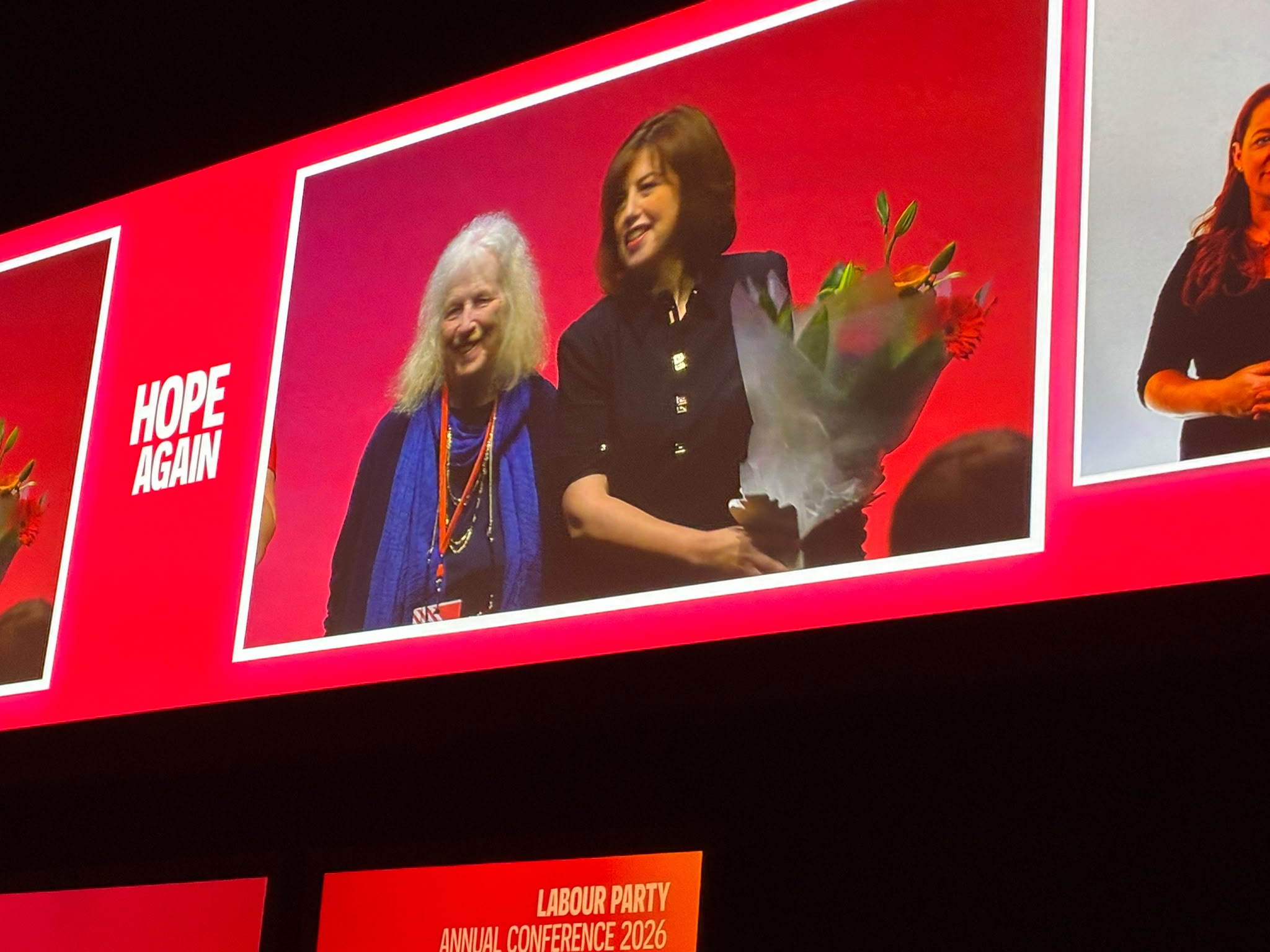
This was followed by merit and best practice awards, and I was honoured and touched by the flowers and applause, nearly 30 years after I first spoke at conference in 1997 urging delay to Partnership in Power …
Into the 21st Century
Moving on, conference was happy with the NEC rule changes and enthusiastically supported – with 99% of the vote – the Disability Labour amendment which adds these words to the rulebook:
“It shall be a duty of the CLP to seek to ensure, as far as possible, that General Meeting and Branch Meetings can be attended by all those entitled to attend. To full [?? fulfil ??] this duty and the party’s anticipatory duty under the Equality Act, hybrid meetings may be organised, in accordance with guidelines laid down by the NEC. Any such guidance must ensure all participants whether in person or online have equal voting and speaking rights.”
Delegates highlighted its value for carers, families, disabled members and those without transport, and some had attended more meetings during Covid lockdowns than before or since. I have been raising this for years, and look forward to the guidelines. Two notes: first, not all CLPs have facilities for fully hybrid meetings, and second, the NEC has not agreed procedures for secret ballots within its own meetings and may need to learn from you. These are essential for CLPs holding AGMs and nominating for national committees. It is also not clear if candidate selections will be covered, but this is a giant leap forward.
Disappointment …
Pressure for electoral reform has been building steadily: in 2021 80% of constituency delegates backed proportional representation, as did the whole of conference in 2022. This year more than 40 motions calling for a national commission on electoral reform were submitted and accepted by the CAC. However when CLP delegates chose their six priorities for debate electoral reform was in seventh place with 78,023 votes, narrowly behind fairness for older workers with 82,135 votes. Various slates tell their supporters which topics to back: the Campaign for Labour Party Democracy suggested only the Middle East and Cuba while Labour to Win, currently dominant, listed five, with the sixth as a choice between electoral reform and violence against women and girls. VAWG was already on the agenda from the women’s conference, but understandably it was also preferenced by many delegates. Reformers were deflated, facing another year of grinding through motions and considering tactics to overcome the slate mentality.
… and Hope Fulfilled
Nevertheless Labour for a New Democracy (L4ND) and the indefatigable Laura Parker never give up, and won through a higher principle: if the leader wants something it will happen. After taking last year’s L4ND fringe meeting by storm, this year as prime minister Andy Burnham delivered his unequivocal commitment to a national commission and a pledge in Labour’s next manifesto to change the system so that every vote counts, and the door to Number 10 cannot be opened to divisive forces on less than 30% of the electorate. There is much work to do to win the arguments and develop the details, and please join L4ND at https://www.labourforanewdemocracy.org.uk/, Make Votes Matter at https://makevotesmatter.org.uk/ or the Labour Campaign for Electoral Reform at https://www.labourcampaignforelectoralreform.org.uk/
The Speech
As I said on social media this was the best leader’s speech that I can remember. Listing highlights – a national care service, protecting homes and savings, parity of esteem between technical and academic careers, responsibility for those not in education, employment or training, recognising that today’s young people have a harder time than we did, unlocking working-class aspiration, standing with Ukraine, taking back control from those who gave it away in the first place, the UK’s future relationship with Europe – doesn’t do it justice. It was more the sense of a leader saying what he truly believes rather than reading out autocue lines which have been focus-grouped to death. Even if you disagree, it keeps you awake. Vibes alone will not be enough, but it’s now on all of us to go out and make change happen.
Goodbye to X
Thank you for the many kind responses to my post, and your good wishes as I leave the NEC. These have been mixed with legitimate disagreement:
“I’ll wait to see how you’re going to pay for all of this before I start rejoicing. Surely you must be asking yourself the same question.”
“So a great speech but no mention of the Defence budget, illegal migration or the cost of living crisis. Think he avoided the people’s top concerns to appear popular with the far left.”
rapidly descending into mindless abuse:
“Say goodbye to your heating this winter you old c**t”
“F**k off you cretin”
So this will be my last political post on X. I will change my username and hang around solely to keep up with figure skating.
The Best of the Rest
John Healey’s chancellor’s speech was restrained, but it is right to save key announcements for the budget rather than set off weeks of hints and leaks. The biggest cheer was for his promise to restore the Union Learning Fund, an excellent measure but not enough to win elections on its own. I trust his instincts and hope there is enough scope in an economic environment so much worse than that inherited by Gordon Brown in 1997. Ed Miliband was also impressive, and other ministers are building their profiles. I still have questions about what devolution means for the south-east region, with 91 Westminster constituencies and not a single mayor or strategic authority. In Oxfordshire we don’t even know what form local government will take, as three different options are still in play and in May 2027 elections will be on the old structures. It is hard to retain staff, deliver services or manage funding with continuing uncertainty.
More to Do
After the effort that Ellie Reeves put into the NPF I was disappointed that the policy seminars only attracted 10-15 delegates. An 8:30 a.m. start is not ideal but I’m sure that last year attendance was closer to 40, and they allow delegates to talk to ministers away from the media spotlight. I attended two. On foreign policy I urged restoration of international aid to 0.7% of GDP, instead of the further cuts to 0.3% which led my MP Anneliese Dodds to resign as a minister, and was promised that Kirsty McNeill is on the case.
The second was on work and pensions, where the main message from delegates was that the main need is not to prepare people for the world of work, but to encourage employers to give them a chance. Graduates cannot get entry-level professional jobs despite numerous applications, and a delegate with epilepsy was rejected out of hand for desk jobs despite his academic and professional qualifications. He knew of many similar cases where employers would not even consider disabled applicants.
NEC Meeting, Tuesday 29 September 2026
This was the AGM at the close of conference where the NEC welcomes new members, thanks those who have left, and elects officers for the year ahead. Deputy leader Lucy Powell did the honours while Andy Burnham made his way through the post-speech media melee, thanking Maggi Ferncombe, Cerys Way, Mick Whelan, Yasmine Dar, outgoing treasurer Mike Payne, Ellie Reeves, myself and Ellen Morrison-Smith, who was praised as the first NEC disabled members’ representative, always making sure that their voices were heard at the top of the party.
Ellie and I joined the national policy forum within two years of each other and our paths have crossed many times, as a student and council candidate in Oxford, as constituency representatives on the NEC, at interviews for parliamentary seats in 2017, and on the NPF, and it seemed fitting that we should leave together. Many kind things were said, and I recalled that I was first elected to the NEC on the leftwing grassroots alliance slate, lost to Momentum in 2018, and returned with encouragement from Labour First in 2020, without changing any of the principles that I hold while the world moves around us.
Peter Wheeler was then elected as chair by the new NEC, with Ian Murray of the Fire Brigades Union unanimously elected as vice-chair. This is Ian’s second time after the turbulent years when longer-serving members were bypassed, and he will undoubtedly progress to chair next year. Like Ellie from the other side he stayed loyal to the party through difficult times, and earned respect from all. Trade union representatives sometimes find it hard to convince their own members that Labour is worth it, and we should remember that.

Andy Burnham then thanked us all for getting to where we are now and urged us to bring everything we have to the fight ahead. I reminded him of his previous visits to Oxford for leadership hustings in 2010 and 2015, said he would be welcome to return, and was proud to accept my second leaving certificate.
Democracy in the Balance
Others will now take the party forward and I wish them all the best. For me it is a natural time to leave but – and I always have a but – I am concerned about members losing their role in electing NPF representatives. And not only because it took me ten years to change from conference elections to one-member-one-vote, now abandoned.
First, around 20% of CLPs do not send any delegates to conference, and second, youth representatives are elected only by delegates aged under 27. The Scottish NPF youth representative was elected by 153 votes to nil, which looks like one CLP out of 73. Members in the other 72 had no say. The north-west youth was elected by 1,505 to 1,374 votes and the south-east youth by 2,946 to 2,738 votes. I don’t have numbers for individual CLPs, but it seems that members in 80% of CLPs were disenfranchised. So I would be asking how many CLPs were represented at conference, and how many sent any young delegates.
Interestingly the party used to publish much more information. I have records for the national constitutional committee elections at conference in 2014 and 2015, including how each CLP cast their votes. These show 373 CLPs voting in 2014 and 300 in 2015, already fewer than half the total. I also have the full record of decisions for 2005, when NPF representatives were still elected by conference, showing how every CLP cast their votes for the CAC, the NCC and the NPF within regions, with participation rates up to 70%. I would love to know what they are now. Records of decisions used to be available to anyone who asked, and I assume that they are still produced.
But the lesson is this: party democracy does not rely only on giving members rights, but on members using the rights which they have. OMOV for the NPF was dropped because turnout was too low to justify the expense of the ballots. Turnout for the NEC elections in 2024 was only 12.9%. There is a warning there: use your vote, or you will lose it. These are issues for my successors – it’s time for me to move on.
Reflections: What a Long Strange Trip It’s Been …
My political journey started in the trade union movement in the 1980s when I joined NALGO, the local government white-collar union, at Oxford Polytechnic, now Oxford Brookes University, where I worked as a computer programmer. I became a workplace steward, staff side member, conference delegate, branch chair and branch secretary. Their training courses were first-rate and I learned everything I know about procedures, representation, negotiation, collective responsibility, running a branch and teamwork from my union.
NALGO was not affiliated to the Labour party, but I took that experience into my local party branch and then the constituency party as a delegate, chair, and then secretary for 25 years. In 1993 NALGO merged with NUPE and COHSE to form UNISON. I was elected to the regional LabourLink and then the national LabourLink committee, sitting alongside the wonderful Angela Rayner, while continuing my party progression through the constituency route. I attended my first Labour conference as a delegate from Oxford East CLP in 1995. My involvement in the national party grew from curiosity about the national policy forum and a chance encounter with Peter Hain, who put me in touch with a small centre-left group called Labour Reform, which brokered the original Grassroots Alliance. It’s a long story …
Going back to the 1980s, at Oxford Polytechnic I was also a member of the Academic Board and then the Board of Governors, representing the support staff and fighting for parity of esteem with the lecturers. That is when my colleagues and I started reporting on meetings, aiming to inform and entertain without engaging in personal attacks or causing trouble. From time to time the management tried to shut us down, but we resisted with polite determination. Those newsletters were a model for all that followed.
I retired from Oxford Brookes in 2015. I missed the leaving do organised by my UNISON branch because it clashed with an NEC post-mortem into the May 2015 defeat, but friends kindly recorded the speeches as well as consuming all the food and wine. The chair summed up my NEC reports as having
“sufficient detail to make them interesting, enough explanation to convey the importance of what’s being discussed, concise enough to be readable, above all sufficiently honest that you get a flavour of what’s happened regardless of what the official line is, but there is not a single thing that the enemies of the party in the Tory press can use to damage the party”.
I could not wish for a better understanding of what I have tried to achieve. For 25 years I’ve aimed to keep that balance, asking members to read between the lines as well as along them while never giving hostages to our political and media enemies, and if I’ve succeeded, then it has all been worth it. Thank you to everyone who has written, helped, argued, advised and joined me on the way, and good luck for the future. There is everything to play for.
Ann Black, Labour Party National Executive Committee Constituency Representative, 2000-2018, 2020-2026